Paid a Vietnamese Company's Director Personally: Who Must Refund You?
A transfer to a Vietnamese company director’s personal account may be recoverable, but the liable party depends on authority, corporate recognition and whether the payment was duplicated.
If you paid a Vietnamese company's director into a personal bank account, you may have a recoverable claim—but you must first establish who received the money legally and why. A director's name on a bank transfer does not automatically make the director personally liable, nor does it automatically prove that the Vietnamese company received payment.
For foreign purchasers, the problem becomes especially urgent when the company later requests another transfer to its corporate account. Before paying twice or demanding a refund, establish whether the personal-account payment was authorised, credited against the contract price, or held independently by the individual.
1. Did payment to the director discharge your obligation to the company?
The answer depends on the agreement, authority and subsequent conduct. Article 280 of Vietnam's Civil Code 2015 requires monetary obligations to be performed in accordance with the agreed time, place and method. Where the contract designates the company's bank account, a transfer to a personal account presents an additional question: did the company authorise or accept that alternative?
Articles 141–143 of the Civil Code address the scope of representation and the consequences of acts undertaken without authority or beyond it. Article 12 of the Enterprise Law governs a company's legal representatives. A person described as “director” or “general manager” is not necessarily authorised to receive every corporate payment privately.
A foreign buyer should avoid treating either of the following propositions as automatic: that a payment to an individual has discharged the corporate debt, or that the company can ignore a payment it expressly authorised and accepted.
What happened?
Key issue to prove
An authorised corporate representative instructed the buyer to use a personal account
Was that instruction valid, and did the company recognise the payment?
An employee or manager sent personal banking details informally
What was their authority and how did the company respond?
The company issued a receipt or credited the advance
Does the accounting and correspondence connect the payment to the corporate contract?
The individual received and retained funds without the company's involvement
Is there a valid basis for that individual to keep the money?
The beneficiary was not the intended payee
Consider a payment-error trace and possible restitution claim
2. A second payment was made to the company's account: is the first refundable?
Consider this hypothetical transaction. An overseas buyer orders services worth USD 12,000 from a Vietnamese company. Before the corporate documents are completed, the buyer wires USD 3,000 to an account personally held by the company's director, following a written request. Later, the buyer's finance department wires the full USD 12,000 to the corporate account. The director replies that the initial USD 3,000 will be returned, but no refund follows.
The buyer should not immediately describe the initial payment as fraudulent. It first needs to establish four things: whether the USD 3,000 and USD 12,000 related to the same services; whether the later USD 12,000 payment was for the entire contract value rather than the balance; who benefited from the earlier USD 3,000; and in what capacity the director agreed to refund it.
If the company recorded both transfers for the same obligation, a contractual reconciliation and repayment demand may be appropriate. If the individual retained a payment without lawful basis, Articles 579 and 580 of the Civil Code may become relevant, subject to the applicable law and evidence.
Any recovery calculation must credit payments already refunded or otherwise set off. Seeking the same overpayment twice from two different parties without distinguishing the legal bases risks an unsustainable claim.
3. Who should receive the demand: the company, the director or both?
Start by separating the commercial debtor from the bank-account beneficiary.
A company may bear responsibility if its authorised representative directed the payment, it subsequently approved the arrangement, or it treated the sum as an advance received under the contract. Where the company rejects the transaction, the buyer should investigate the exact instruction, the individual's authority and whether corporate conduct amounted to recognition.
An individual may face a separate repayment claim where the money was received or retained without a lawful basis. Article 579 of the Vietnamese Civil Code deals with possession or enrichment without legal grounds; Article 580 addresses return of the assets or their value. These provisions should not be used as a shortcut where the recipient has a plausible contractual or agency basis for holding the funds.
A message stating “I will refund it” is significant, but its meaning depends on context. Was the director assuming a personal undertaking? Was the director merely reporting that company accounting would make the refund? Who was supposed to initiate the payment, and from which account?
The prudent course is often to send a factual reconciliation request to both parties, without asserting joint and several liability unless the law or an enforceable undertaking supports it.
4. Evidence checklist for a personal-account transfer
Cross-border recovery depends heavily on documentary continuity. A banking confirmation proves that a transfer was initiated or completed; it does not independently establish the legal purpose of the payment.
Evidence
What it helps establish
Purchase or service contract, quotation, order confirmation
The contracting entity, price and scheduled payments
Email or messaging instruction containing the personal account
Who requested the transfer and in which capacity
Bank debit advice, remittance reference, SWIFT confirmation where available
Amount, date, currency and named beneficiary
Subsequent corporate-account payment
Whether a second payment was made and what the reference stated
Corporate receipt, ledger confirmation or debt reconciliation
Whether the Vietnamese company acknowledged the original advance
Refund acknowledgment and follow-up correspondence
Who accepted responsibility, amount and proposed refund date
For email, Zalo, WeChat and other messaging platforms, keep the complete thread and available metadata. A screenshot of a bank-account number or refund promise is more persuasive when linked to the commercial negotiations, the contract and the identity of the sender.
Prepare a chronology showing instruction → first payment → contract confirmation → second payment → refund acknowledgment → follow-up. Identify any gaps openly; do not backdate documents or invent an authorisation letter after the dispute arose.
5. Can the sending bank reverse the transfer?
Contact your sending bank promptly and request any available trace or recall process. For an international transfer, ask for the transaction reference, beneficiary details and the status of the funds. The available procedure and prospects of recovery depend on the banks, payment system, jurisdiction and stage of processing.
A transfer deliberately made to the account that the counterparty supplied is not the same as typing an unintended beneficiary account number. A commercial dispute over repayment should not be misrepresented as an accidental transfer error.
The State Bank of Vietnam has explained, in a public response concerning mistaken transfers, that Article 579–580 of the Civil Code and Circular 17/2024/TT-NHNN are relevant to repayment and account inquiries. That guidance does not mean a bank is authorised to debit a customer's personal account on demand merely because the payer alleges a contractual overpayment. Read the official guidance.
The sender should preserve communications with both banks, but pursue the underlying contract or restitution claim separately if the trace does not resolve the dispute.
6. Does the CISG determine who is liable for the personal transfer?
Not necessarily. Where the underlying transaction is an international sale of goods, the United Nations Convention on Contracts for the International Sale of Goods (CISG) may govern parts of the buyer–seller relationship if its conditions are satisfied and it has not been validly excluded. Vietnam has been a CISG Contracting State since 1 January 2017 and has an Article 96 declaration; the writing issue must be assessed carefully.
However, Article 4 confines the Convention principally to the formation of the sale contract and the resulting buyer–seller obligations, while excluding certain questions such as validity. Questions involving a director's authority, a separate personal undertaking or unjust enrichment may need to be resolved under other applicable rules. Do not assume the CISG alone identifies the person liable for repayment of an off-contract personal-account transfer.
For a cross-border service contract, the CISG ordinarily does not provide the governing framework. Depending on the transaction and the forum, Article 683 of the Vietnamese Civil Code and relevant private international law rules may require examination of a choice-of-law clause and the closest connection.
The proper forum is a separate issue. A clause selecting arbitration between two companies will not necessarily bind a director in an individual capacity. Review the parties, scope and form of the dispute-resolution agreement before naming respondents.
7. Five practical recovery steps for an overseas buyer
Step 1 — Freeze the evidence trail
Preserve the contract, the payment instruction and all bank records. Do not delete message threads when a staff member leaves or a project group closes.
Step 2 — Identify the legal and operational parties
Check the Vietnamese company's registered legal name and whether the relevant individual was a legal or authorised representative for the transaction. An employee's designation alone is not conclusive.
Step 3 — Reconcile the advances
Request written confirmation of how the personal-account payment and corporate-account payment were booked. Ask whether the first sum was treated as a customer advance, transferred onward or retained separately. Distinguish assertions from documentary evidence.
Step 4 — Issue a reasoned repayment request
State the transfer amounts and dates, the agreed contract price, why the funds appear duplicated and the basis for requesting repayment from the identified recipient. Set a clear response deadline and attach a transaction schedule.
Step 5 — Decide on settlement or proceedings
Assess the amount, evidence, time limits, forum and enforceability. If a personal reimbursement promise is documented, review whether it creates an independent enforceable undertaking or merely records the company's intended action. Legal proceedings may involve the company, the individual or different causes of action; these alternatives require careful pleading, not unsupported joint-liability allegations.
8. Can a complaint to police substitute for a repayment claim?
No. Non-payment after a promise to refund, evasive communications or use of a personal account does not by itself establish fraud or another criminal offence. A criminal complaint should be considered only when there is credible evidence of particular criminal conduct, not as a routine debt-collection lever.
Where the facts show a commercial overpayment or an unsupported personal retention of funds, civil or commercial remedies should be evaluated on their own merits. The potential effectiveness of any claim also depends on identifying accessible assets and the correct party against whom a decision could be enforced.
9. Working with Vietnamese counsel remotely
A foreign buyer may organise records and engage counsel without immediately travelling to Vietnam. Depending on the proceedings, foreign corporate documents, powers of attorney, translations and authentication requirements may need to be satisfied. The exact formalities must be verified, including any treaty exceptions.
Justix assists businesses with contractual and evidence review, identification of the proper claimant and respondent, repayment demand letters, negotiation strategy and dispute-resolution documentation within the agreed engagement. Deliverables can include a transaction chronology, an evidence-gap list, a legal assessment and a quantified claim schedule.
The bank beneficiary and the legally responsible debtor are not always the same person. Establishing that distinction early can prevent a second mistaken payment and improve the quality of any recovery action in Vietnam.
Legal basis
Vietnam Civil Code 2015: Articles 141–143, 280, 579–580 and 683, where the Vietnamese law is applicable.
Vietnam Enterprise Law 2020, as amended: Article 12 on the legal representative of an enterprise.
Comments are moderated before they appear. Only replies marked “Verified by Justix” come from Justix — we never contact anyone using a phone number left in a comment. Read our impersonation warning
No comments yet. Be the first to share your thoughts.
Ask a lawyer about this
Your question goes privately to a lawyer and is not published.
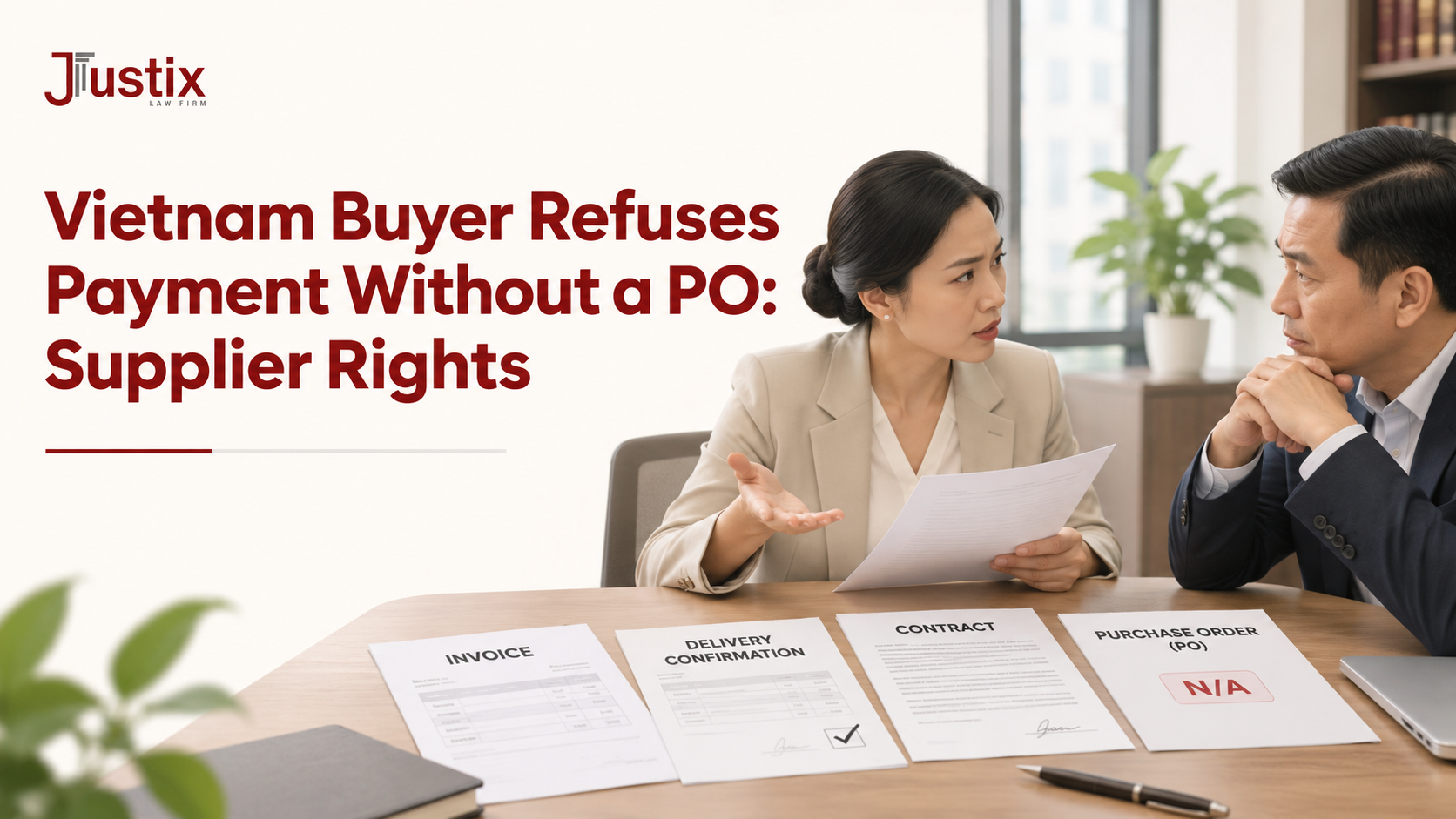
When a Vietnamese customer invokes a no-PO-no-pay policy after delivery, the supplier must distinguish a contractual purchase-order requirement from an internal accounts-payable obstacle and establish authority, acceptance and the amount due.
A missing signature does not necessarily prevent a service provider from recovering fees from a Vietnamese client. The outcome depends on contract formation, evidence, applicable law and payment conditions.
A force majeure notice does not automatically discharge unpaid purchase money. Assess the governing law, payment impediment, evidence and separate claims for price, interest and damages.