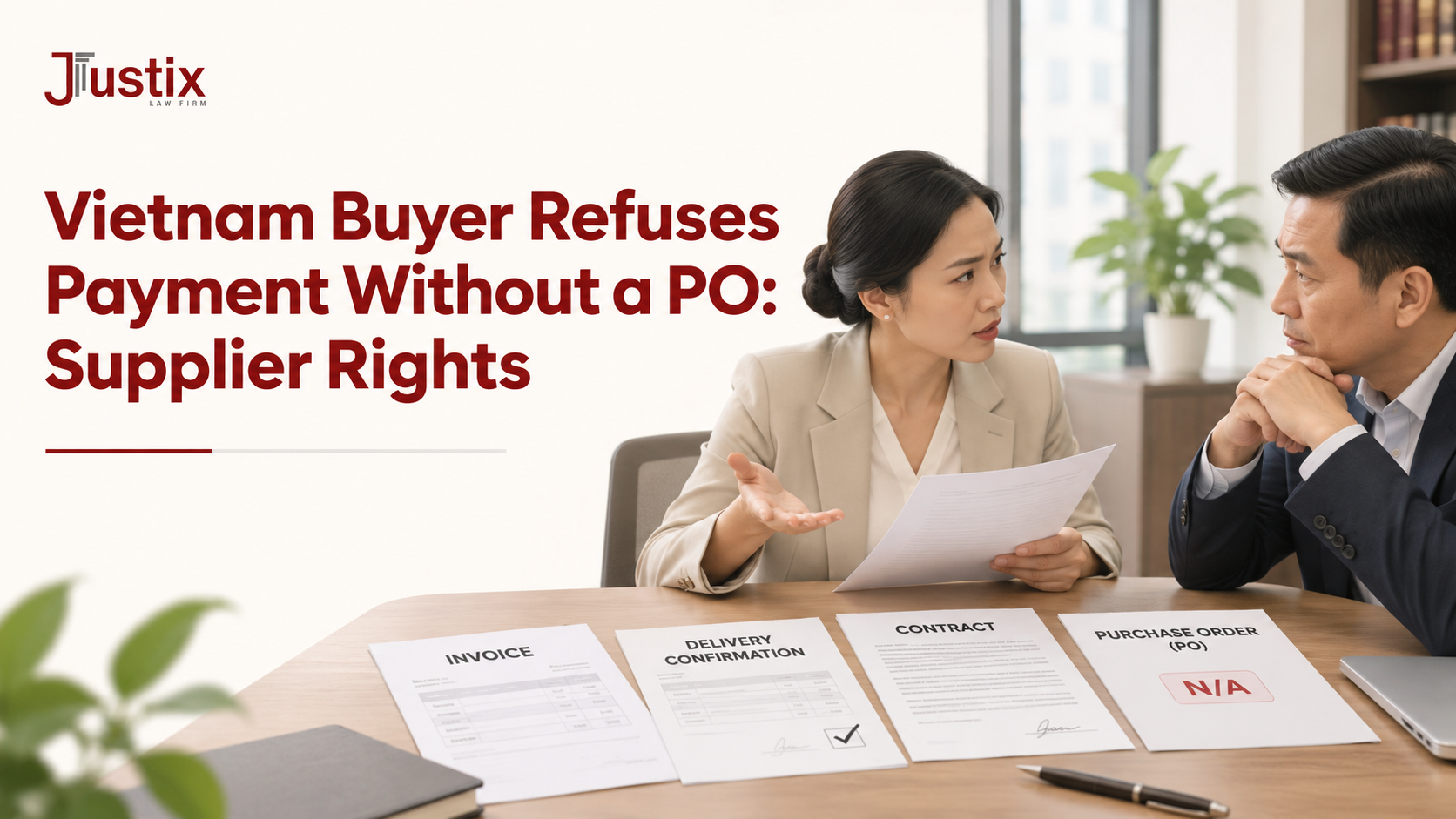
Vietnam Customer Refuses Payment Without a Purchase Order: Supplier Options
When a Vietnamese customer invokes a no-PO-no-pay policy after delivery, the supplier must distinguish a contractual purchase-order requirement from an internal accounts-payable obstacle and establish authority, acceptance and the amount due.
A Vietnamese customer's missing purchase order (PO) does not automatically extinguish a valid payment obligation. But a supplier cannot assume the opposite either: an agreed “no PO, no contract” requirement, an unauthorised employee's instruction or an unaccepted delivery may materially weaken the claim. The first step is to determine what the customer actually agreed to, who placed the order and what evidence shows that payment is due.
1. Is “no PO, no pay” a contractual defence or an internal processing rule?
Many procurement systems require an approved purchase order number before accounts payable releases an invoice. That rule helps a buyer control spending and verify that the invoice matches an authorised order. Its legal effect on an external supplier depends on how the rule entered the transaction.
A PO may be (i) the instrument by which the buyer accepts the supplier's quotation, (ii) an ordering document under an executed master supply agreement, or (iii) a record generated after a deal has already been authorised. Separately, employees sometimes use “PO” loosely for a payment order or approval ticket created only after work is completed.
What is missing?
Question for the supplier
Approved purchase order
Did the contract say that only an approved PO creates an order?
Internal purchase requisition
Was the internal approval process communicated and incorporated into the deal?
Receipt/acceptance record
Has delivery or satisfactory performance actually been established?
Accounts-payable ticket
Is the debt acknowledged but blocked by the customer's workflow?
Publicly available procurement terms illustrate why the distinction matters. Some buyers expressly make PO issuance a condition of purchasing; others treat a missing PO number as an invoice-processing exception that can be corrected. Such external policies are examples of commercial practice, not Vietnamese legislation and not proof of any particular Vietnamese customer's terms.
2. Four scenarios with different legal outcomes
A. The supplier agreed that no order exists until an approved PO is issued
Review the signed master agreement, incorporated purchasing conditions, quotation and negotiation emails. A clear condition that orders must be made through authorised POs can be significant. A delivery made solely at an employee's informal request may be exposed if the employee lacked authority and the buyer did not subsequently approve the transaction.
Nevertheless, subsequent acceptance or ratification by the proper company representatives may change the analysis. This is evidence-specific: a warehouse receipt, by itself, is not always equivalent to corporate ratification of every price or term.
B. The buyer agreed to purchase, then failed to create its internal PO
Suppose authorised buyer personnel approved the price and delivery, goods arrived and the buyer retained them. An accounts-payable failure to generate a PO number would not automatically undo a valid contractual payment obligation. The supplier should request debt confirmation and a documented process for the buyer to regularise its payment file, without backdating documents.
C. The order was placed by someone whose authority is disputed
Under Articles 142 and 143 of Vietnam's Civil Code 2015, transactions made without authority or beyond a representative's authority do not necessarily bind the represented company, subject to statutory qualifications such as ratification, knowledge without objection within a reasonable time, or fault causing the counterparty not to know of the authority problem.
Review the employee's role, delegations, prior authorised transactions, management approvals and corporate conduct. Do not assume a corporate email address is conclusive evidence of contracting authority; equally, a buyer's assertion that an employee “was not authorised” is not the end of the inquiry.
D. The supplier cannot yet prove acceptance or that payment is due
An unanswered quotation, disputed delivery or express condition precedent may mean the supplier has not established its claim. Separate accepted and unaccepted quantities, pricing disputes, defective goods allegations and any genuine contractual holdbacks.
3. Which law governs the purchase and payment obligation?
For domestic Vietnamese commercial transactions, the Civil Code 2015, Commercial Law 2005 and applicable special legislation may govern contract formation, representation and payment. Articles 24 and 74 of the Commercial Law address forms of sale-of-goods and service contracts, while Articles 50 and 55 address payment in sales and Articles 85 and 87 address service payment under their respective conditions.
For foreign suppliers, do not assume Vietnamese domestic law applies solely because the buyer is Vietnamese. The governing-law clause, conflict-of-laws rules, contract type and relevant treaties must be examined.
International sales and the CISG: a critical reservation
For an international sale of goods falling within the UN Convention on Contracts for the International Sale of Goods (CISG), Articles 53 and 59 address the buyer's obligation to pay and payment when due; Articles 62 and 78 address certain seller remedies and interest. Applicability and any contractual exclusion must be checked first.
Vietnam became a CISG Contracting State on 1 January 2017 and made a declaration under Articles 12 and 96. Accordingly, the Convention's freedom-of-form provisions do not apply in the usual way where a party has its place of business in Vietnam. This does not automatically mean every PO must be a wet-ink document: the relevant applicable law and rules on electronic writing still need analysis. It does mean that a supplier should not simply cite CISG Article 11 and conclude that any oral sale is enforceable.
The CISG does not govern pure service contracts. Mixed goods-and-services arrangements require a separate scope analysis, including Article 3 where relevant.
4. What evidence is most useful if the buyer refuses to process the invoice?
Delegation records, approval chains, manager emails, earlier orders approved by the same personnel.
Delivery
Shipping records, bills of lading, warehouse receipts, delivery notes, acceptance or inspection reports.
Buyer conduct
Evidence of retention, use, resale or management acknowledgment, where lawfully obtainable.
Debt amount
Accepted price, invoice, credit notes, payment ledger, statement of account.
Objection
AP rejection notice identifying the missing PO, contract clause relied upon and proposed correction process.
For electronically negotiated orders, preserve original emails and files, relevant metadata and complete threads. Vietnam's Law on Electronic Transactions 2023 recognises legal effects and evidentiary relevance of qualifying data messages, while the Civil Procedure Code governs how evidence is assessed in litigation. A single screenshot may not prove the sender's authority, authenticity or the full agreement.
5. Example: goods received but the procurement system has no PO
Hypothetical example. An overseas component supplier receives an email from a Vietnamese manufacturer's project team confirming specifications, price and a requested delivery date. The supplier ships the goods; the manufacturer's warehouse signs for them. Accounts payable later says the invoice cannot be processed because no approved PO exists.
Before demanding payment, counsel would need to test whether an approved PO was an expressly agreed formation condition; whether the project team had authority; whether the buyer subsequently approved or accepted the transaction; what the delivery records establish; and which law governs the sale. Where the CISG applies, Vietnam's Article 96 declaration must also be taken into account.
Neither “goods arrived at the warehouse” nor “the SAP system has no PO” resolves all these questions by itself.
6. A practical recovery sequence for suppliers
Ask what “PO” means. Request the rejected-invoice notice, procurement rule and contractual provision relied on.
Identify the correct purchasing entity. Match the buyer's legal name and contracting personnel to the invoices and delivery documents; a group affiliate is not automatically liable for another entity's purchase.
Prepare an order-to-payment chronology. Record the quotation, acceptance, approvals, shipment, receipt, invoice, payment date and the buyer's refusal.
Separate process exceptions from genuine disputes. Request written confirmation of any uncontested debt; address missing records without creating false or backdated documents.
Send a reasoned payment demand. State the contractual basis, supporting evidence, sums due, applicable interest if supportable and a specified response date.
Assess settlement, arbitration or litigation. Review forum clauses, any valid written arbitration agreement, limitation periods, costs and enforceable assets before filing.
The fact that a financial year has closed or an audit has been completed does not by itself establish that a debt has ceased to exist. Accounting corrections and invoice compliance may need separate attention, but must not be confused with the underlying contractual claim.
7. What about dispute resolution, interest and limitation?
For a claim governed by Vietnamese commercial law, Article 306 of the Commercial Law may be relevant to interest on overdue payments where its requirements are met. Article 319 generally provides a two-year limitation period for commercial disputes, subject to exceptions. Other causes of action or governing laws can produce different results.
Arbitration in Vietnam requires a valid arbitration agreement that meets the formal requirements of Article 16 of the Law on Commercial Arbitration 2010; the supplier cannot assume the procurement dispute is automatically arbitrable before its preferred institution. Cross-border enforcement of judgments or awards requires a distinct review.
8. Reducing risk on future Vietnamese orders
Before supplying, agree on the authorised ordering channel, whether POs are a condition of contract formation or merely a payment reference, the effect of urgent email approvals, delivery acceptance, invoice requirements and the process for correcting missing PO numbers. Specify who can amend an order and when a payment deadline begins.
If the buyer imposes “no PO, no pay” terms, suppliers should request POs before shipment or obtain a properly authorised exception in a recognised written or electronic form. A supplier should not assume its own quotation overrides duly incorporated purchasing conditions.
9. Legal support from Justix
Justix handles commercial contract disputes, including review of ordering terms, corporate authority and delivery evidence, assessment of the outstanding claim, preparation of payment demands and support for negotiation or formal proceedings within an agreed engagement. Deliverables can include a legal assessment, evidence schedule, debt calculation and dispute documents.
The decisive issue is whether the missing PO was an enforceable condition agreed between the parties or an internal payment-processing omission after a binding obligation had already arisen.
Comments are moderated before they appear. Only replies marked “Verified by Justix” come from Justix — we never contact anyone using a phone number left in a comment. Read our impersonation warning
No comments yet. Be the first to share your thoughts.
Ask a lawyer about this
Your question goes privately to a lawyer and is not published.
A missing signature does not necessarily prevent a service provider from recovering fees from a Vietnamese client. The outcome depends on contract formation, evidence, applicable law and payment conditions.
An overseas buyer that paid a Vietnamese supplier but received no goods should check delivery obligations, the governing law, CISG remedies, payment evidence and the realistic options for shipment or refund.